The Strategic Imperative: Breaking the Illusion of Oversight
In the high-stakes corporate environment of 2026, the primary threat to Malaysian Boards is no longer just external volatility, but an internal failure of perception rooted in “Compliance Theater“. This phenomenon occurs when organisations adopt sophisticated risk frameworks like COSO or ISO for symbolic legitimacy while the underlying structural and behavioral realities continue to suppress transparency and candor.
For the modern Director, receiving filtered or “safe” information is an existential threat to fiduciary duty. When the Chief Risk Officer (CRO) or internal audit functions are structurally subordinated to the executives they are meant to oversee, the Board is effectively operating in a state of epistemic blindness. To safeguard shareholder value and ensure long-term resilience, Boards must pivot from principle-based checklists to a Structural-Behavioral Architecture: the implementation of the Risk Culture Reform Model (RCRM).
The Failure of Principle-Based Governance: A Record of Insufficiency
Traditional risk management standards have proven necessary but fundamentally insufficient in preventing catastrophic failures. The paper identifies a recurring pattern where formal frameworks are overridden by structural power dynamics:
- The Symbolic Compliance Trap: Frameworks like COSO and ISO 31000 emphasise “tone at the top” but lack granular enforcement mechanisms for functional independence. This allows organisations to claim adherence while maintaining incentive systems that actively encourage misconduct.
- The Culture of Silence: Case studies such as the Boeing 737 MAX crisis reveal how cost-saving pressures and a lack of psychological safety can silence engineers even when technical warnings are documented.
- Misaligned Incentives: The Wells Fargo account fraud scandal demonstrated that even with formal audit functions, misaligned incentive subsystems can corrupt behavior across an entire organisation.
- Systemic Sidelining: Scandals like 1MDB in Malaysia and Wirecard in Germany highlight how governance leaders can be systematically manipulated or ignored when they lack board-controlled protection.
The Structural Underpinnings of Cultural Failure
To reform culture, we must first understand the “hard-wiring” of hierarchy and authority that shapes it. The paper interrogates several organisational theories to explain why risk culture fails:
- Weber’s Bureaucratic Rigidity: While hierarchy ensures accountability, it often suppresses candor by creating fear of consequences for speaking up.
- Fayol’s Administrative Conflict: The principle of “unity of command” often results in CROs reporting administratively to CEOs, creating a direct conflict of interest regarding compensation and career progression.
- McGregor’s Theory X vs. Theory Y: Fear-driven Theory X cultures create silence, whereas empowerment-oriented Theory Y environments are required for a risk-aware culture to thrive.
- Institutional Isomorphism: Organisations often adopt governance “best practices” not for effectiveness, but to conform to external norms for reputational legitimacy.
The Solution: The Risk Culture Reform Model (RCRM)
Authentic governance is not a set of values; it is a structural outcome. The RCRM provides a causal pathway that moves from foundational reform to cultural results.
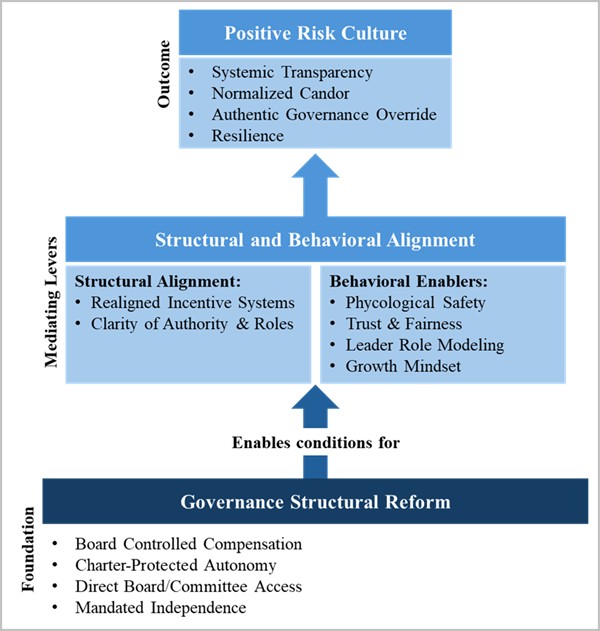
Pillar 1: Governance Structural Reform (The Foundation)
Meaningful change is impossible as long as the risk function is subordinated to the CEO. This pillar mandates non-negotiable structural actions:
- Board-Controlled Compensation: The Board or Risk Committee must have the sole authority over the hiring, firing, and budget of the CRO.
- Charter-Protected Autonomy: The “right to speak” must be formally codified, guaranteeing the CRO unfettered, private access to the Board without executive presence.
- Mandated Independence: Establishing “hard” functional reporting lines that override “soft” administrative ties to management.
Pillar 2: Structural and Behavioral Alignment (The Mediating Levers)
Once the structural foundation is secure, it creates the “space” for cultural enablers to function:
- Incentive Realignment: Systems must reward integrity and long-term resilience, directly addressing the “profit-at-all-costs” mentality.
- Psychological Safety: This is the primary behavioral enabler. Because risk leaders are board-protected, they can challenge executives without fear, role-modeling candor for the rest of the organisation.
- Clarity of Authority: Clearly defined roles ensure that the flexibility of modern agile or matrix structures does not create dangerous blind spots.
Pillar 3: Positive Risk Culture (The Outcome)
A positive risk culture is the result of the first two pillars, characterised by:
- Systemic Transparency: Information flows freely because the structures mandate it.
- Normalised Candor: Speaking truth to power becomes a rewarded norm rather than a career risk.
- Authentic Governance: The Board receives unfiltered intelligence, allowing for genuine oversight and strategic mastery of uncertainty.
Contextual Realities: High Power-Distance and the Malaysian Landscape
The RCRM is particularly critical in contexts like Malaysia, where high power-distance or collectivist cultures can prioritise hierarchy and harmony over dissenting truth. In such environments, “soft” behavioral initiatives are insufficient. “Hard” structural protections (board-controlled independence) are the only mechanisms strong enough to protect a risk leader and guarantee the candor required to prevent a repeat of crises like 1MDB.
A Roadmap for Stakeholders
Implementation of the RCRM redefines roles across the governance ecosystem to ensure “structural integrity” over “symbolic rituals”.
Table 1: The Transformation Pathway
| Stakeholder | The Old Way (Compliance Theatre) |
The New Way (Authentic Governance) |
|---|---|---|
| Boards of Directors | Passively reviewing filtered, “safe” reports from executive-led functions. | Actively controlling CRO pay and mandating private sessions to surface uncomfortable truths. |
| Chief Risk Officers (CROs) | Acting as administrative custodians, often buried in reporting lines. | Evolving into independent strategic advisors protected by formal charters and board access. |
| Regulators | Promoting principle-based codes that allow for symbolic adoption. | Mandating structural independence and auditing psychological safety as a core metric. |
| Exec. Management | Decoupling strategy from risk; treating risk as a cost or a “box” to be ticked. | Modeling transparency and aligning enterprise-wide incentives with long-term resilience. |
| Assurance Functions | Operating in silos, creating redundant work and “false comfort.” | Becoming an integrated ecosystem that maps coverage against mission-critical uncertainties. |
Practical Implications for Boardroom Leadership
To move beyond compliance theater, Boards must adopt the following mandates:
- Assume Control of the CRO Contract: Transition the reporting and compensation structure of the CRO directly to the Risk Committee.
- Audit the “Silence”: Demand that internal audits and risk assessments include “behavioral audits” or psychological safety scores to detect where information is being suppressed.
- Publicly Reward Candor: Directors must role-model and publicly commend instances where risk leaders or employees surface “bad news” early.
- Extend Basel Principles: Even for non-financial sectors, adopt the prescriptive independence standards usually reserved for banking.
Conclusion: From Cataloging History to Mastering Uncertainty
Risk culture is the invisible architecture that determines whether an organisation survives or collapses under pressure. The evidence is clear: principle-based frameworks alone are insufficient when undermined by CEO-dominated power dynamics and misaligned incentives.
The Risk Culture Reform Model (RCRM) provides Malaysian Boards with a practical blueprint to bridge the gap between “sensing” a risk and having the “agency” to act on it. Organisations that fail to protect the independence and psychological safety of their risk leaders are not just vulnerable; they are complicit in creating the blind spots that lead to catastrophe. The time for symbolic compliance has passed; the time for structural integrity has arrived.
Dr. Shaharin is a Governance and Assurance professional with over 25 years of local and international experience transforming risk management from a compliance checklist into a driver of business value. His expertise spans complex and highly regulated sectors such as Banking & Financial Services; Railways & Logistics; FinTech; Property & Construction; and Oil & Gas, with a geographic footprint across Malaysia, Kuwait, Qatar, and the UAE. His professional insights and writing are rooted in this extensive field experience, offering a unique synthesis of real-world application and deep technical knowledge.
- Architect of Integrity Ecosystems: Served as the primary architect for a national banking institution’s corruption risk management ecosystem, building the entire framework from the ground up to ensure institutional integrity.
- Strategic Risk Leadership for Conglomerates: Driven the adoption of advanced risk frameworks for major conglomerates, ensuring resilience for some of the significant players.
- Champion of Governance Reform: A Ph.D. in Management, focused on corporate governance structural reform, he specialises in guiding Boards through complex regulatory landscapes.
Connect with Dr. Shaharin: shaharin.abdulsamad@gmail.com | www.linkedin.com/in/sas118 |
Read the full academic paper here: Integrating Structural Independence and Behavioral Science for Resilient Risk Culture
The article was written by Dr. Shaharin Abdul Samad.
Photo by Alvaro Reyes on Unsplash.


Related Stories

 5.0
5.0  7 Minutes
Strategic Boards in Malaysia: The Shift from Compliance to Leadership
15 June 2026


 5.0 7 Minutes
From Compliance Theater to Authentic Governance: A Framework for Risk Culture Inte...
26 March 2026
 5.0 4 Minutes
The Risk Culture Management Framework (“RCMF”): Filling in the gap of Risk Cul...
23 October 2025

 5.0 20 Minutes
Why Trust is Essential for Whistleblowing Programs to be Effective
27 March 2025
 5.0 6 Minutes
The Fourth Q – What It Is and Why It’s Essential for High Performing C...
16 December 2024