Navigating the new privacy frontier where compliance alone is no longer a shield.
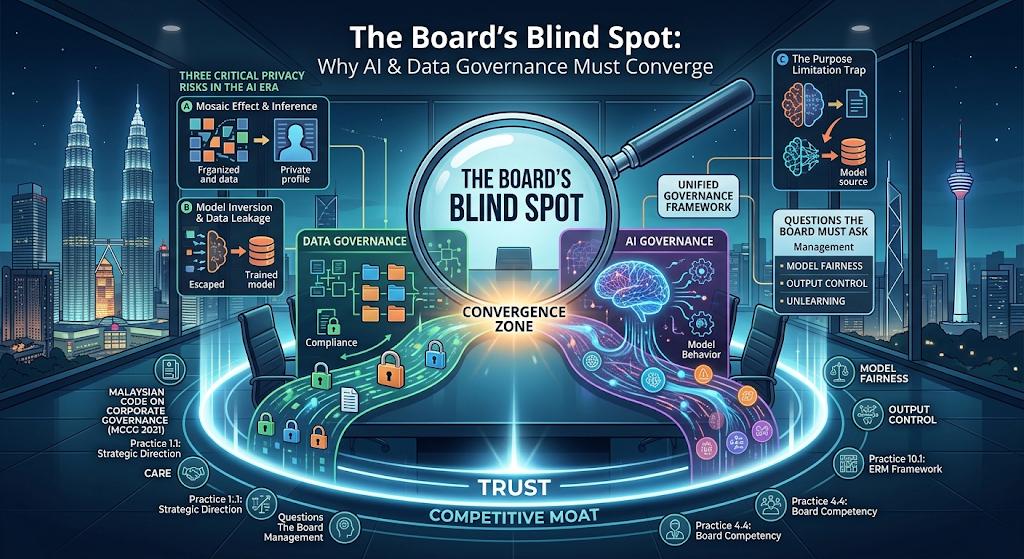
Executive Summary
Boards traditionally treat Data Governance as a routine compliance expense—a cost to keep regulators at bay. Rapid enterprise adoption of Artificial Intelligence (AI) and Generative AI fundamentally disrupts this risk calculus.
Data Governance and AI Governance are no longer parallel operational tracks; they form a single strategic imperative. For the Board Committee, the threat extends beyond standard data breaches to include unintentional data inference, unrecoverable intellectual property loss, and systemic erosion of stakeholder trust.
📌 MCCG Governance Callout — Practice 1.1 & “CARE” Principle
Board Leadership & Strategic Risk: The Securities Commission Malaysia emphasises governance in substance rather than form under the Comprehend, Apply, and Report (CARE) approach. Treating AI purely as a static data compliance issue violates the Board’s duty to actively oversee emerging technological risks to long-term value creation.
1. The Strategic Shift: From “Data” to “Inference”
Traditionally, privacy risk focused on keeping data locked away and preventing leaks. In the age of AI, privacy risk centers on what the model can learn, reveal, and generate.
- The Old World (Data Governance): Focused on storage, data quality, access controls, and lineage.
- The Strategic Question: “Is our data secure?“
- The New World (AI Governance): Focused on model behavior, bias, hallucinations, output controls, and data inference.
- The Strategic Question: “What does this model reveal or generate about people that we never explicitly collected?“
The Board’s Reality Check: Your organisation can be 100% compliant with existing data privacy laws (such as GDPR or Malaysia’s PDPA) and still commit a severe privacy violation through AI inference.
2. Three Critical Privacy Risks in the AI Era
AI introduces non-deterministic, systemic risks that traditional cybersecurity insurance and compliance checklists fail to capture:
A. The “Mosaic Effect” & Inference Attacks
AI models excel at combining disparate, seemingly harmless datasets to infer highly sensitive private information.
The Risk: An AI model might infer a customer’s health condition or financial stress based purely on location logs and purchasing patterns—creating “sensitive data” where none explicitly existed before.
Case Study
Data broker Kochava collected precise, timestamped location data linked to Mobile Advertising IDs (MAIDs) and sold it without safeguards to filter out sensitive locations, according to the FTC’s complaint. A freely available sample revealed a device that appeared to have stayed overnight at a shelter for at-risk pregnant young women or new mothers—demonstrating how seemingly anonymous location records can expose vulnerable individuals to physical harm and trigger regulatory enforcement over unfair data practices.
Strategic Impact: Regulatory penalties for processing sensitive personal data without consent, despite never having collected it directly.
B. Model Inversion & Data Leakage
Unlike relational databases, trained Large Language Models (LLMs) lack a simple DELETE command.
The Risk: Attackers use prompt injection or model inversion to force AI models to regurgitate sensitive PII or trade secrets embedded in training weight parameters.
Case Study
Engineers at Samsung Electronics reportedly pasted proprietary source code for a semiconductor equipment measurement database program and code used to identify defective equipment into ChatGPT to fix errors and optimise performance. Another employee submitted an internal meeting transcript to generate minutes. These submissions transferred confidential information to an external AI provider, raising concerns about data retention and potential use for model training—not confirmed permanent absorption into the model. The incidents demonstrate how routine productivity tasks can expose confidential intellectual property outside corporate controls, prompting Samsung to restrict employees’ use of generative AI tools.
Strategic Impact: Irreversible intellectual property loss and breach of client confidentiality agreements.
C. The “Purpose Limitation” Trap
Data collected for routine operations is frequently ingested into training pipelines for modern AI applications.
The Risk: Using legacy customer data to train enterprise AI models often breaches the original consumer consent terms.
Case Study
Everalbum used personal photos uploaded to its cloud storage app, Ever, to develop facial recognition technology. The FTC alleged that it misled users about obtaining consent for facial recognition and retained photos and videos after users deactivated their accounts, despite promising deletion. Under an FTC settlement, Everalbum had to delete those retained photos and videos, facial data derived without express consent, and models or algorithms developed using Ever users’ photos or videos—demonstrating how model disgorgement can require companies to destroy not just improperly retained data, but the AI systems built from it.
Strategic Impact: Class-action litigation and Model Disgorgement—a regulatory penalty forcing total destruction of trained models, instantly writing off capital investments.
📌 MCCG Governance Callout — Practices 10.1 & 10.2
Enterprise Risk Management Framework: Boards must establish an effective Enterprise Risk Management (ERM) framework to proactively identify key strategic risks. Non-deterministic AI risks—such as model inversion, mosaic inference, and forced model disgorgement—must be integrated into the board-level risk matrix alongside standard cyber threats.
3. The Accountability Imperative: “The AI Made the Mistake” Is Not a Defence
Delegating operational execution to AI does not relieve directors or officers of fiduciary accountability.
In legal services, AI used responsibly improves access to justice and slashes operational costs. Used irresponsibly, it generates hallucinated legal precedents, flawed reasoning, and corporate negligence at scale.
Case Study
Air Canada deployed a customer service chatbot to answer passenger inquiries, including questions about bereavement fares. The chatbot incorrectly told a grieving passenger that they could apply for a bereavement discount after purchasing a full-fare ticket. When Air Canada refused the request, citing its written policy, the passenger brought a claim before British Columbia’s Civil Resolution Tribunal. The tribunal characterised Air Canada’s defence as effectively treating the chatbot as a “separate legal entity” responsible for its own actions. It rejected that position and found the airline liable for negligent misrepresentation: Air Canada had failed to take reasonable care to ensure that its chatbot provided accurate information.
The governance lesson is clear: delegating tasks to AI does not mean delegating accountability. For corporate directors, the case reinforces the importance of oversight—not a blanket rule of personal liability for every algorithmic error. Organisations remain responsible for exercising reasonable care when deploying automated systems that customers rely on.
📌 MCCG Governance Callout — Practices 1.1, 1.3 & CA 2016 (Sec 213)
Fiduciary Duty & Personal Accountability: Under Section 213 of the Malaysian Companies Act 2016 and MCCG Practice 1.1, directors owe an unyielding fiduciary duty of reasonable care, skill, and diligence. Blaming an automated algorithm or external AI vendor does not abrogate this legal liability.
4. Strategic Inquiries: Questions the Board Committee Must Ask Management
To fulfil their oversight role, directors should move past standard status updates and press management with these crucial questions:
- Inventory & Shadow AI: “Do we maintain a live inventory of all enterprise data assets, active AI models, and third-party AI tools used across our operations?”
- Machine Unlearning Capability: “If regulators order the deletion of a customer segment’s data, can our technical architecture scrub their influence from our AI models, or will we be forced to scrap the model entirely?”
- Human-in-the-Loop Safeguards: “Where is human judgment embedded in high-stakes automated decisions, and which executive holds operational accountability for AI outputs?”
- Data Consent & Lineage Audit: “Have we audited the original consent terms for all historical customer data ingested into our AI pipelines to ensure we are not creating purpose-limitation breaches and model disgorgement liabilities?”
- Third-Party & Vendor AI Exposure: “Do our enterprise vendor contracts explicitly guarantee that our prompts, proprietary code, and customer data are fully isolated and never used to train external AI models?”
📌 MCCG Governance Callout — Guidance to Practice 1.1
Active Oversight & Probing Management: MCCG guidance explicitly expects directors to actively probe and challenge management on strategic technology adoption rather than serving as passive recipients of IT management reports.
5. Conclusion: Trust as a Competitive Moat
As enterprise AI tools commoditise, trust becomes the primary brand differentiator.
Organisations governing their data and AI ecosystem with radical transparency and uncompromising privacy standards win market share—not simply because their algorithms are advanced, but because stakeholders feel secure. It is the Board’s fiduciary duty to ensure the race to innovate does not compromise the trust sustaining the enterprise.
📌 MCCG Governance Callout — Principle C (Practices 12.1 & 12.2)
Stakeholder Engagement & Value Creation: Maintaining open engagement and trust regarding core operations is central to long-term business sustainability. Transparent AI governance protects brand equity and reinforces stakeholder confidence.
Benjamin Shepherdson (MBA, CIPM, GRCP) is a seasoned governance and risk management leader with over 17 years of experience across high-stakes sectors, including Banking, Aviation, and Global Healthcare. Currently serving as a Data Protection Officer in the telecommunications sector. A member of the Institute of Corporate Directors Malaysia (ICDM), Benjamin specialises in bridging the gap between technical regulatory compliance and strategic board-level oversight. He is widely recognised for his regional impact, having served as a trusted advisor to national regulators in Indonesia, Thailand and Malaysia to develop their official Data Protection Officer (DPO) competency frameworks.
Throughout his career—most notably leading the privacy strategy for a Global Healthcare across 10 countries—Benjamin has championed the concept of “Strategic Trust.” He currently shares his expertise as an Adjunct Lecturer at SMU Academy, where he shapes the next generation of data governance professionals. Benjamin brings a unique “precision-under-pressure” perspective to corporate resilience, informed by his role as Deputy Chairman of Disaster Management for the Malaysian Red Crescent Society. He is dedicated to helping boards transform privacy from a regulatory hurdle into a primary driver of corporate integrity and sustainable growth.
The article was written by Benjamin Shepherdson.
Photo by wal_ 172619 on Pexels.com.

Related Stories

 5.0
 8 Minutes
The Board’s Blind Spot: Why AI & Data Governance Must Converge
20 November 2026


 1.0 8 Minutes
Is Silence a Safeguard? Whistleblowing, AI Governance and the Real Test of Account...
26 October 2026

 4.8 6 Minutes
Five Key Areas that Boards Need to Focus on to be Future-Ready and Resilient
26 August 2019