As board responsibilities expand, now is the time to assess your board’s effectiveness.
Beyond ensuring effective organisation performance, boards of directors are relied upon to serve as effective long-term stewards for their organisations while being responsive to a variety of stakeholders. In turn, stewardship has evolved into an overarching principle that incorporates five key dimensions — each of which is essential for long-term resilience, visibility and growth (Figure 1).
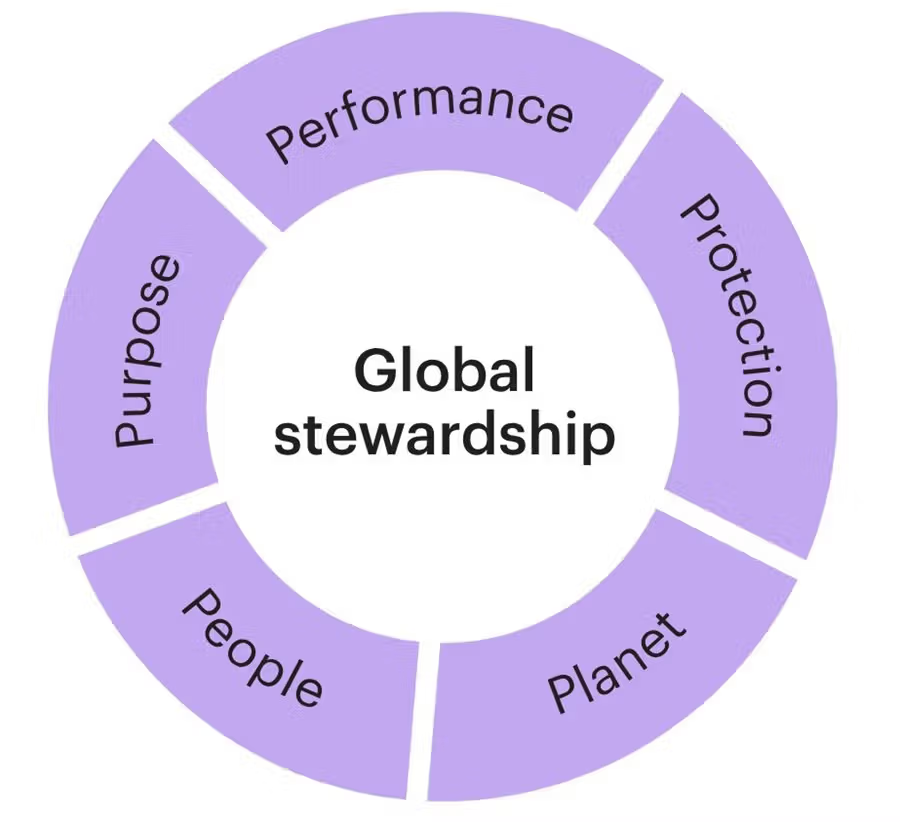
For a long time, boards have performed self-evaluations to support their performance and as a matter of good corporate governance. In fact, governance codes and stock exchange requirements around the world call for boards to perform self-evaluations. However, self-evaluations can be a suboptimal approach.
Usually conducted annually via questionnaire, they can yield limited insights, with input weighted toward positive-only feedback. Moreover, the very nature of self-assessments is to highlight solely the directors’ input, and lack of a third-party facilitator and/or input from management can hinder objectivity and balanced perspectives.
In recent discussions with WTW, board members have expressed urgency for board effectiveness in response to increasing complexity, stakeholder pressure and technological change. Because the traditional self-assessment process can be insufficient, a more holistic approach can dig further into the board’s effectiveness in serving as an enterprise’s governing steward.
Board members have expressed urgency for board effectiveness in response to increasing complexity, stakeholder pressure and technological change.
Assessing Board Effectiveness
To further support the board’s stewardship — and to dive deeper than the annual evaluation process — a board effectiveness assessment is performed to:
- Review board practices and processes
- Evaluate board culture
- Assess board diversity and composition
- Understand individual stewardship styles
- Monitor board dynamics and interactions
We suggest that boards incorporate an approach that includes seven key steps, each of which can vary in complexity and be tailored to the unique needs of both organisations and their boards.
- Board assessment questionnaire – Board members complete self-assessment questionnaire. This includes responses from management.
- Board of director interviews – Interviews conducted with boards and senior management to obtain insights on board effectiveness.
- Board processes review – Develop analysis of the board and committee charters, breadth of remit and responsibilities, meeting frequency, agenda, minutes and key papers, and other relevant corporate governance materials.
- Diversity and board composition review – Desktop analysis and assessment of board composition (social and professional diversity), and setup (structure and composition) benchmarked against peer groups.
- Individual stewardship styles – Board members complete an online assessment of individual professional styles. This also helps assess balance of profiles across the full board.
- Board dynamics assessment – Observational assessment on dynamics and conduct of board members during the meeting.
- Action planning workshop – Presentation to the board with key findings, strengths and gaps, including potential suggestions for enhancement.
Beginning with a tool-based questionnaire completed by both board members and senior management, the process explores different topics and culminates in an action planning workshop. In this meeting, the board hears key findings on strengths and opportunities, recommendations for moving forward, and an action plan for enhancements. Having an external advisor facilitate the full process fosters open dialogue while enhancing confidentiality.
Making the Case for an Effectiveness Assessment
Board effectiveness assessments are an important step toward strengthening the board’s quality of governance. The goal is to reach beyond the status quo to proactively explore the board’s composition, function and communication. There are several sound reasons to conduct this type of assessment.
A Catalyst for Fresh Perspectives
Effectiveness assessments provide a launch point for rethinking practices and raising standards. An assessment also helps ensure the board is living up to its purposes of:
- Making responsible decisions
- Optimising value creation
- Navigating the dimensions of corporate stewardship
- Helping the organisation become its best as it moves through different life cycles and strategies
Whether a publicly traded company, privately held organisation or a not-for-profit entity — and regardless of organisation size — the learning and opportunity outcomes of a board effectiveness assessment can inspire positive change for every type of board.
An Analysis of Board Diversity and Composition
From breadth and depth of skills and experiences to suitability with the organisation’s strategy, operations, culture and geographic coverage, board effectiveness assessments enable the board to determine whether it has the right mix of profiles to meet current and future challenges. An assessment also can lead to action toward leadership succession management, beginning with the board and continuing with the CEO and other C-suite leaders.
A Preassure-Test for Communication and Unexpected Challenges
The proper functioning of an organisation requires constructive interactions among board members as well as between the board and management. An effectiveness assessment can pressure-test communication and uncover unproductive sources of friction. It also can identify differences in decision-making methods before they become a source of conflict. Finally, an assessment can test the board’s ability to respond and navigate through crises.
No Time like the Present
Five years ago, boards of directors helped their management teams and organisations navigate through a global pandemic that had far-reaching implications on strategy, operations, risk mitigation, people and culture, sustainability and stakeholder primacy. Among our clients, we have watched boards become even stronger and more effective from that unexpected challenge.
Today, the world has entered yet another period of economic and social uncertainty and geopolitical instability with parallel challenges (e.g., climate change, influence of AI on how work is done, cybersecurity risks) that apply new pressures to purpose, people, planet, protection and performance.
Now is the time to step beyond the annual self-evaluation and perform a holistic board effectiveness assessment to prepare your board for the next phase of challenges and opportunities.
The first publication of this article was in Directors & Boards on May 27, 2025, and it was published by wtwco.com.
Photo by Vlada Karpovich on Pexels.com.


Related Stories

 5.0
5.0  5 Minutes
Assessing Board Effectiveness in Preparation for Upcoming Challenges and Opportuni...
30 December 2025


 5.0
5.0  1.0 4 Minutes
Why Good Boards Make Bad Decisions: Four Factors Undermining Board Effectiveness
05 May 2025

 5.0 9 Minutes
Balancing Demand and Reward: The New Portfolio Company Chair
19 September 2024