The Strategic Imperative: Breaking the “Theater of Compliance”
In the high-stakes corporate environment of 2026, the primary threat to Malaysian Boards is no longer just external volatility, but an internal failure of perception rooted in “Compliance Theater“. For decades, the boardroom has relied on the Risk Matrix, the ubiquitous grid of red, yellow, and green boxes as the primary artifact of oversight. However, research demonstrates that this traditional matrix has devolved into a “ritual of reassurance.” It provides a veneer of control while masking the structural and temporal realities of modern, hyper-connected threats.
For the modern Director, receiving a “Green” risk report is no longer a signal of safety; it is often a symptom of epistemic blindness. When boards prioritise risks based on “Likelihood,” they are using what is essentially a proxy for ignorance. To fulfill their fiduciary duties in an era of polycrisis, Boards must pivot from the performance of “box-ticking” to the operational discipline of Velocity × Impact Intelligence.
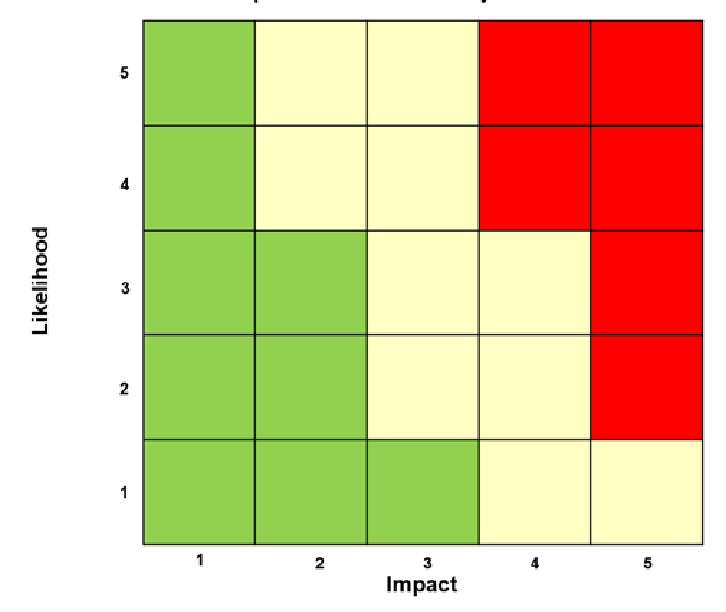
The Failure of the Likelihood Paradigm: A Record of Insufficiency
The traditional Risk Matrix, born from mid-20th-century safety engineering, was designed for linear systems. In today’s volatile landscape, its methodological flaws have become catastrophic liabilities for governance.
1. The Mathematical Mirage
The most fundamental critique is the mathematical invalidity of the matrix structure. Most organisations multiply ordinal scales, treating categories like “Possible” and “Major” as interval numbers to reach a composite score. This is a statistical fallacy that leads to rank reversals where minor risks are elevated, and critical threats are buried simply due to arbitrary grid design.
2. The “Knowledge Illusion”
Traditional matrices force-fit Knightian uncertainty (the unknowable unknowns) into risk calculations. By assigning a probability to a unique, unprecedented event such as a global pandemic, practitioners treat the unknown as if it were a predictable, historical process. This creates an illusion of knowledge, rendering the organisation fragile to Black Swan events. When a Board sees a risk plotted as “Unlikely,” they often conflate the absence of evidence with the evidence of absence.
3. The Signal-to-Noise Crisis
The ritual of populating every cell in a matrix creates a significant signal-to-noise problem. Diligence is often demonstrated through volume filling out forms and ensuring coverage rather than through careful evaluation of strategic priorities. This clutters Board agendas with minor concerns, distracting Directors from the “Dragon Kings“– an extremely large and unique event that possesses detectable precursors but is ignored because they don’t fit the static probability model.
The Psychological Sedative: Why the Matrix Persists
If the Risk Matrix is so fundamentally flawed, why does it remain the dominant artifact in boardrooms? The answer lies in Social Defense Mechanisms.
- Institutional Isomorphism: Organisations adopt these grids to achieve legitimacy. If every peer uses a heat map, adopting one signals “good governance” to regulators, regardless of its actual efficacy.
- The Emotional Prosthetic: Existential uncertainty creates collective anxiety. The matrix acts as a “container” for this anxiety. By converting complex threats into neat “Green Boxes,” the Board receives a sedative that creates a “cognitive stop,” signaling that the threat is neutralised and delegitimising further scrutiny.
- Decoupling: Organisations often maintain a ceremonial facade for auditors while disconnecting these structures from actual daily operations.
The Solution: The Velocity × Impact Framework
Authentic governance requires a move from prediction to readiness. The Velocity × Impact Framework replaces speculative likelihood with observable metrics.
1. The Two Dimensions of Resilience
- Velocity (The Proxy for Urgency): This captures the immediacy of a risk, how quickly it can materialise once triggered. Unlike likelihood, velocity is often measurable through data such as regulatory lead times or system detection lags.
- Impact (The Strategic Consequence): This represents the consequences if a risk is realised, encompassing financial, operational, and reputational damage.
2. The Anatomy of Velocity: Onset vs. Latency
To move beyond ambiguity, Velocity is defined as a function of two variables:
- Onset Velocity: The speed at which a threat escalates from its initial trigger to its full strategic impact.
- Reaction Latency: The time required for the organisation to detect the signal, interpret it, and mobilise a response, the OODA Loop (Observe, Orient, Decide, Act).
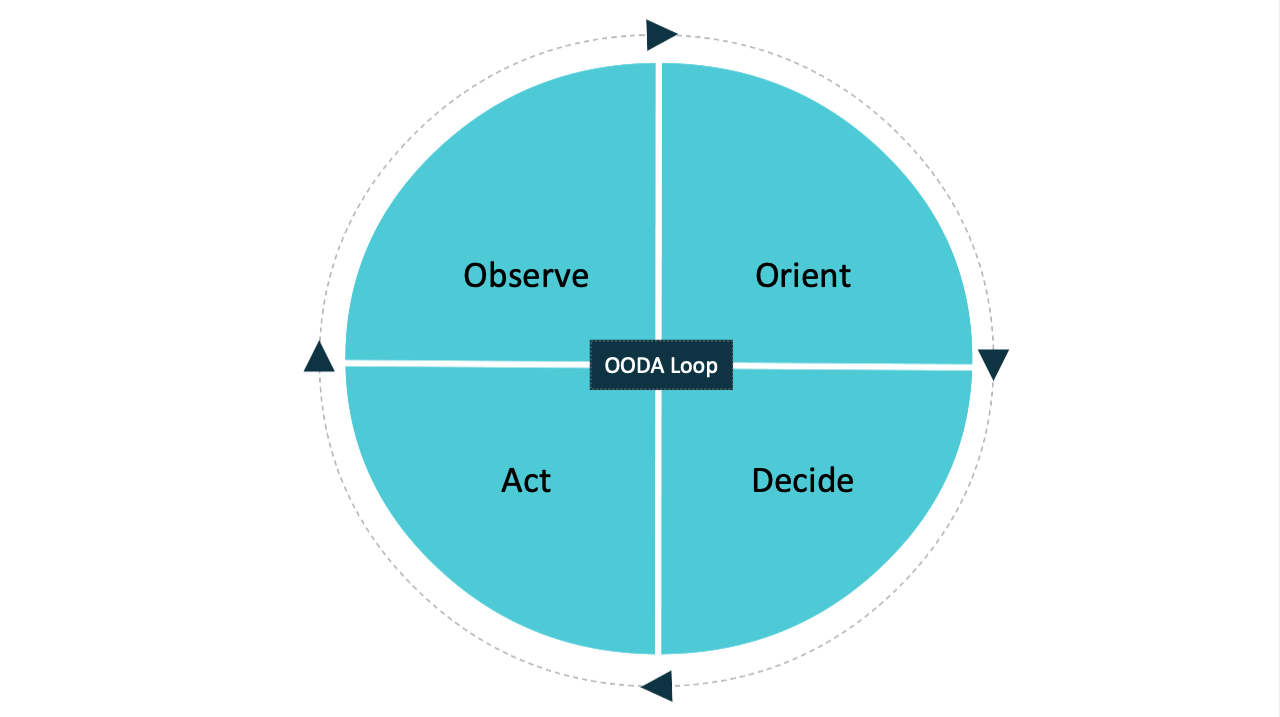
The Governance Danger Zone occurs when Onset Velocity exceeds Reaction Latency. Traditional risk matrices are structurally blind to this deficit. By focusing on Velocity, the Board can identify where their decision cycle is too slow for the risk environment.
Operationalising the Framework: Governance Postures
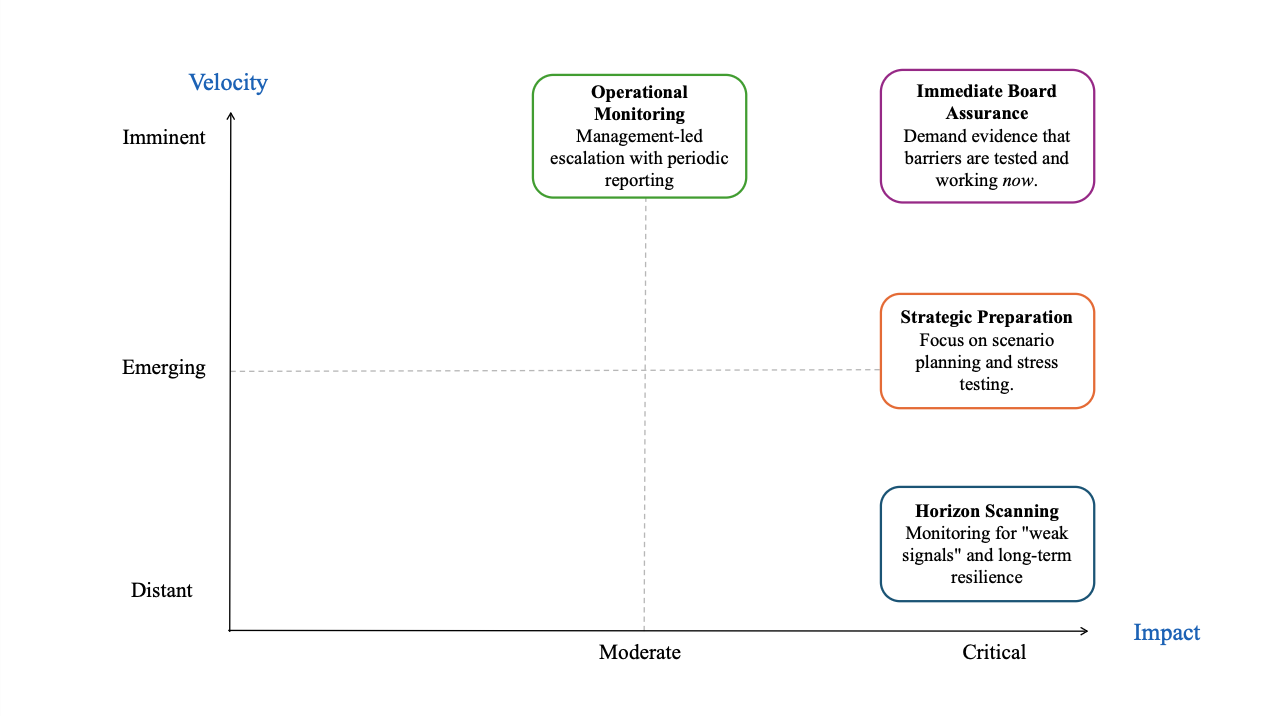
The framework categorises risks into nine distinct postures, ensuring that Board agenda time is an investment in urgency, not a review of history.
| Velocity | Impact | Governance Posture |
|---|---|---|
| Imminent | Critical | Immediate Board Assurance |
| Imminent | Moderate | Operational Monitoring & Escalation |
| Imminent | Limited | Management Oversight |
| Emerging | Critical | Strategic Preparation & Scenario Planning |
| Emerging | Moderate | Periodic Reporting |
| Emerging | Limited | Monitor for Changes |
| Distant | Critical | Horizon Scanning & Resilience Planning |
| Distant | Moderate | Long-Term Monitoring |
| Distant | Limited | Deprioritised |
The “Plausibility Gate”
To avoid “analysis paralysis,” the framework utilises a Plausibility Gate. Risks are only plotted if they are structurally inherent to the organisation’s operating environment. Once a risk passes this gate, the Board stops debating if it will happen and starts interrogating how fast they can respond.
Comparative Application: The Cyber Paradox
To illustrate the divergence, consider a “Zero-Day” Cybersecurity Threat.
- The Traditional Matrix: Because there is no historical data, likelihood is rated as “Rare”. The impact is “High.” The result places the risk in the Green Zone. The Board ignores it, creating a False Negative.
- The Velocity Framework: The Board sees that the Time-to-Impact is minutes (Imminent Velocity), while the “Detection Lag” KRI is 48 hours. The risk is immediately classified as Imminent × Critical. This triggers an automatic mandate for Immediate Board Assurance.
Practical Implications for Boardroom Leadership
To transition from “Ritual to Resilience,” Malaysian Boards must adopt the following mandates:
1. Mandate “Positive Assurance” (Show, Don’t Tell)
It is no longer enough for management to report that a risk is “managed.” For Imminent × Critical risks, the Board must demand Positive Assurance: verifiable evidence that preventive and mitigative barriers have been tested (e.g., penetration tests, disaster recovery drills).
2. Restructure the Agenda (Prioritise Urgency)
The Board agenda should be driven by the Governance Posture. Directors should spend the majority of their time interrogating the risks that threaten the organisation now (Imminent), rather than debating the probability of events that are years away.
3. Audit “Reaction Latency” (The OODA Loop)
Directors must ask: “Is our decision-making speed faster than the risk’s evolution?“. Demand that the Risk Function tracks Detection Lag and Response Time as Key Risk Indicators (KRIs).
4. Foster a Culture of Radical Candor
The Velocity framework dismantles the Theater of Compliance by valuing honesty about what the organisation does not know. Boards should reward managers who disclose mitigation gaps and reaction latency deficits rather than those who provide a sanitised green heat map.
Conclusion: From Cataloging History to Mastering Uncertainty
The Risk Matrix has become a placebo of governance; it offers the illusion of safety while the organisation remains fragile to high-velocity disruption. The evidence is clear: mathematically fragile and cognitively biased tools have no place in a modern boardroom.
The Velocity × Impact Framework provides Malaysian Boards with a practical blueprint to bridge the gap between “sensing” a risk and having the “agency” to act. Organisations that continue to rely on the “sedative” of the green heat map are choosing the illusion of control over the discipline of readiness. The time symbolic compliance has passed; the time Structural Integrity has arrived.
Dr. Shaharin is a Governance and Assurance professional with over 25 years of local and international experience transforming risk management from a compliance checklist into a driver of business value. His expertise spans complex and highly regulated sectors such as Banking & Financial Services; Railways & Logistics; FinTech; Property & Construction; and Oil & Gas, with a geographic footprint across Malaysia, Kuwait, Qatar, and the UAE. His professional insights and writing are rooted in this extensive field experience, offering a unique synthesis of real-world applications and deep technical knowledge.
- Architect of Integrity: Developed national-level corruption risk ecosystems for the banking sector.
- Strategic Risk Leader: Led the adoption of advanced risk frameworks for major conglomerates in Railways, FinTech, and Oil & Gas.
- PhD in Management: His research focuses on the structural reform of corporate governance to ensure institutional resilience.
Connect with Dr. Shaharin: [email protected] | LinkedIn
Read the full academic paper here: From Ritual to Resilience: Replacing the Risk Matrix with a Velocity × Impact Framework
The article was written by Dr. Shaharin Abdul Samad.
Photo by Jahanzeb Ahsan on Unsplash.


Related Stories

 3.2
3.2  8 Minutes
From Ritual to Resilience: Replacing the Risk Matrix with a Velocity × Impact Fra...
08 July 2026


 5.0 8 Minutes
Common Sense as a Risk Capability: The Decline of Deliberate Thinking
03 July 2026
 5.0
5.0  5.0 7 Minutes
Integrating Enterprise Risk Intelligence (ERI) with Mission Critical Objectives (M...
02 January 2026
 5.0 7 Minutes
Digital Innovation in Business Processes: Strengthening Governance, Risk Managemen...
17 December 2025