The Strategic Imperative
Malaysian Boards are facing a dangerous paradox. Since the enforcement of Section 17A of the MACC Act 2009, Public Listed Companies (PLCs) have aggressively proliferated compliance frameworks, filling risk registers and drafting strict policies.
Yet, corruption persists. This creates a terrifying reality for Directors: You can have perfect paperwork and still be liable. This brief argues that the prevailing reliance on “Hard Controls” – structural and procedural safeguards creates a false sense of security, a “compliance illusion” that leaves organisations vulnerable to the very threats they believe they have neutralised.
The “Calculated Compliance” Trap
Why do robust systems fail? The answer lies in human behavior. This paper applies Herzberg’s “Two-Factor Theory” to governance, revealing a critical flaw in modern ABAC strategies. Most PLCs focus exclusively on “Hygiene Factors”- the laws, controls, and audits that prevent dissatisfaction.
While these “Hard Factors” answer the question “What is forbidden?“, they often result only in “Calculated Compliance”. Employees follow the rules to adhere to the letter of the law rather than embracing their spirit. This “check-the-box” mentality treats ethics as a bureaucratic hurdle rather than a core value.
The Solution: The “Dual-Factor” Breakthrough
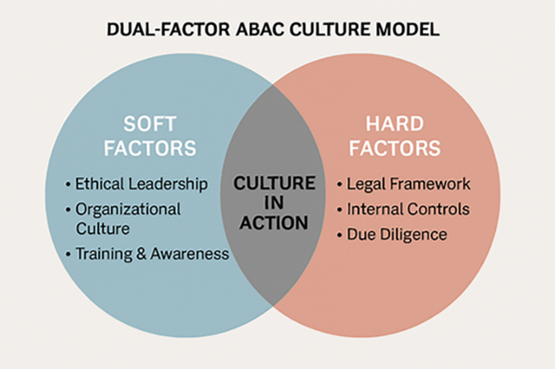
To move from fragile compliance to resilient integrity, Boards must activate the “Motivators” – the “Soft Factors” of culture. The research introduces the Dual-Factor ABAC Culture Model, a framework that proves true protection exists only in the synergy between structure and spirit:
- Hard Factors (The Hygiene): Elements like Section 17A, ISO 37001, and Internal Controls. These are necessary to prevent the “dissatisfaction” of regulatory penalties, but they cannot create a proactive culture of integrity.
- Soft Factors (The Motivators): Elements like psychological safety, ethical leadership (“Tone from the Top”), and trust. These elements answer, “Why does this matter?” and transform employees from passive rule-followers into active guardians of integrity.
The “Culture in Action” Zone
A policy is just paper until it is animated by culture. As illustrated above, sustainable ABAC maturity is found only in the “Culture in Action” zone, the operational overlap where hard procedures are animated by soft values. Without this overlap, a whistleblowing channel is silent not because there are no risks, but because there is no trust.
Implications for Directors This is a call to abandon “appearance-based” governance:
- Audit the Culture, Not Just the Books: Boards must assess not only the adequacy of procedures but the strength of ethical leadership and the “speak-up” culture.
- Demand “Soft” Evidence: Regulators are increasingly looking beyond the mere existence of policies to evidence of genuine commitment, such as employee understanding and cultural climate.
- Use the Diagnostic Tool: This paper offers a governance-ready framework to assess if your organisation is merely compliant by rule, or truly principled by nature.
Dr. Shaharin Abdul Samad is a Governance & Assurance strategist with over 28 years of international experience transforming risk management from a compliance checklist into a driver of business value. A certified Enterprise Risk Management (ERM) professional, he holds a Ph.D. in Management with a research focus on corporate governance structural reform.
Dr. Shaharin has executed high-impact governance mandates across the Oil & Gas, Banking, and Infrastructure sectors in Malaysia, Qatar, and the UAE. His portfolio includes driving advanced risk frameworks for major energy conglomerates like QatarEnergy and Borouge (ADNOC Group). At MBSB Bank Bhd, he was the architect behind the institution’s corruption risk management ecosystem, building it from the ground up. Additionally, he spearheaded the Enterprise Risk and Business Continuity agendas for key national stakeholders, including TRX City Sdn Bhd and Malayan Railways (KTMB).
Dr. Shaharin specialises in guiding Boards and C-Suites through complex regulatory landscapes. He champions the strategic adoption of the “Unfettered Guardian” framework – a robust governance model designed to ensure true independence, agility, and integrity. He maintains active engagement with the Malaysian corporate sector and is available to provide expert guidance to Boards seeking to elevate their Assurance functions.
Connect with Dr. Shaharin: shaharin.abdulsamad@gmail.com
Read the full academic paper here: Determinants of ABAC Culture
The article was written by Dr. Shaharin Abdul Samad.
Photo by Dawid Zawiła on Unsplash.


Related Stories

 5.0
5.0  4 Minutes
The “Compliance Illusion” – Why Checklists Won’t Save You ...
18 December 2025


 5.0 7 Minutes
To Err is Human, But to Prevent Failure is Divine: Why Boards and CEOs Should Embr...
12 August 2025

 1.0 17 Minutes
PwC’s Global Workforce Hopes and Fears Survey 2023 – Is Your Workforce Rei...
29 March 2024
 5.0 13 Minutes
Four Essential Questions for Boards to Ask About Generative AI
17 August 2023
 1.0 15 Minutes
How Do You Harness the Power of People to Double Transformation Success?
21 February 2023