Why Boards Must Rethink in 2026
Many boards initially viewed COVID-19 as a severe but temporary disruption. The prevailing assumption was that once the crisis subsided, global trade, supply chains, and operating models would return to normal. As conditions stabilised, organisations began planning a return to business as usual. That assumption has not held.
What followed was not a temporary disruption, but a structural shift. Sustained trade fragmentation, tariff volatility, and accelerating geopolitical decoupling have reshaped global commerce. These forces are no longer exceptions. They are the baseline.
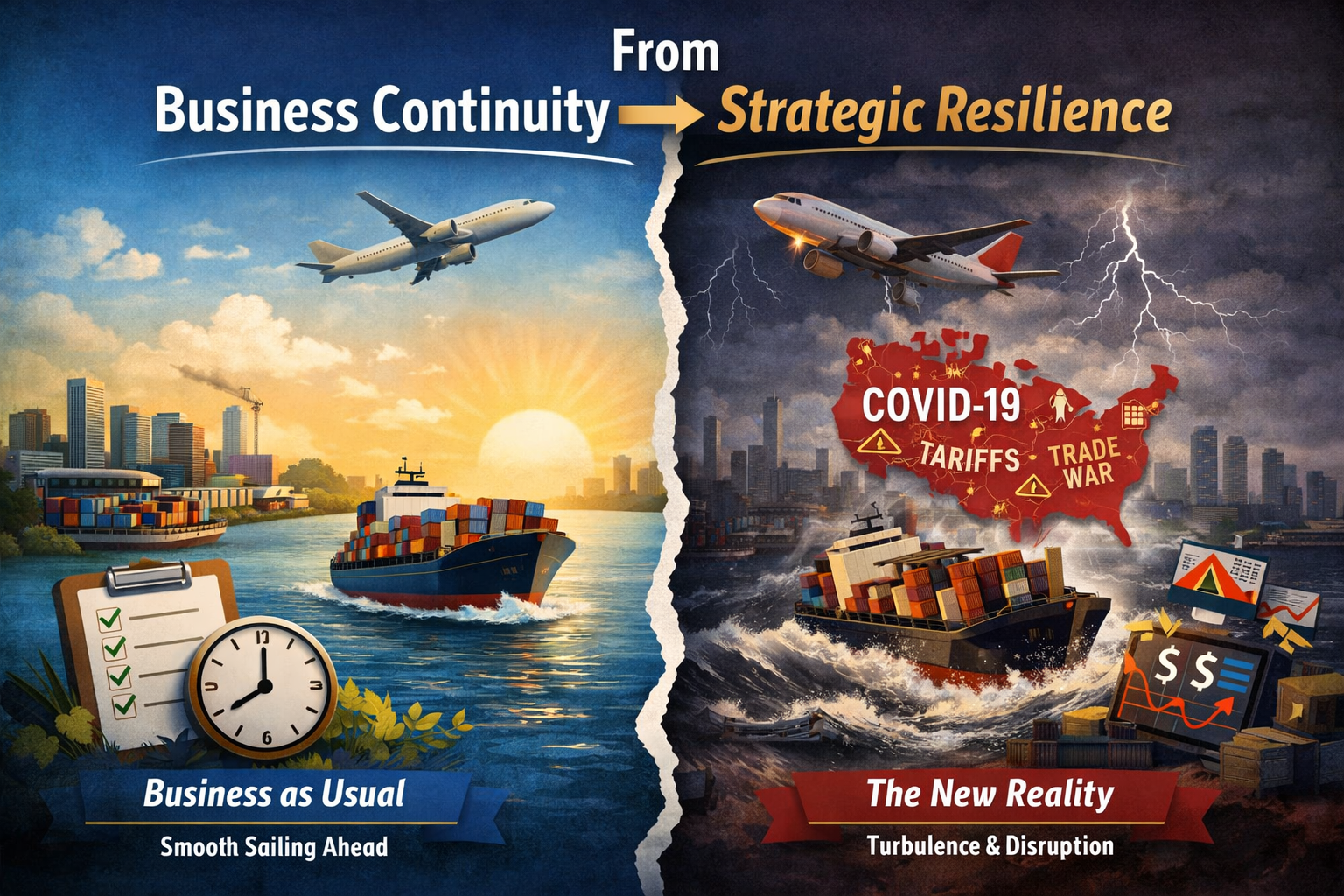
As organisations enter 2026, boards face a fundamentally different risk landscape. Business continuity can no longer remain an operational safeguard. It must become a strategic capability that protects earnings, preserves cash, and sustains competitiveness under prolonged uncertainty.
What COVID Really Taught Boards
COVID-19 did more than test contingency plans. It exposed structural fragilities embedded within many business models. Overconcentration of supply, limited visibility beyond Tier 1 suppliers, and decision making constrained by fragmented or delayed data were widespread weaknesses. These vulnerabilities were not new, but the crisis revealed how quickly they could become existential.
A shortage of a single critical raw material once threatened to halt a billion-ringgit operation. Multiple suppliers failed simultaneously, exposing a fundamental weakness: contingency plans designed for isolated disruptions were not equipped for systemic shocks. The issue was not flawed design, but a shift to an environment where disruptions are interconnected and occur concurrently.
The pandemic also demonstrated how secondary disruptions amplify fragility. The 2021 grounding of the Ever Given, a container ship in the Suez Canal was operationally brief, yet its impact was disproportionate. It occurred at a moment when inventories were low, logistics capacity was constrained, and supply and demand imbalances were acute. What would normally have been manageable became widespread production delays, service failures, and working capital strain.
After COVID-19, similar patterns emerged through policy driven shocks. Abrupt tariff changes left cargo stranded in transit, as companies delayed clearance decisions amid uncertainty over duties, pricing, and contractual exposure. These disruptions were not physical, but decisional. In fragile systems, delayed decisions can be as damaging as operational breakdowns.
The core lesson for boards is clear: the greatest risk is not disruption itself, but the inability to make timely, well informed trade-offs under uncertainty.
There is also a fundamental timing issue. Developing continuity capabilities during a crisis leads to suboptimal and costly decisions. Preparedness must come before disruption.
Why Risk No Longer Reverts to Normal
Today’s environment is structurally different. Trade fragmentation, regulatory divergence, and geopolitical tension are no longer exceptions. They are baseline conditions. For boards, this translates into sustained margin volatility, structurally higher working capital, duplication of supply networks, and rising regulatory complexity.
Traditional continuity planning, designed for temporary disruption followed by recovery, is no longer sufficient. The assumption of a return to normal is now itself a risk.
The Role of Digitalisation and AI
Digitalisation improves visibility across increasingly complex supply and operating networks, but visibility alone is not enough. The real value lies in enabling better decisions, earlier.
Artificial intelligence has the potential to move organisations from reactive response to anticipatory insight. It can detect early signals of disruption, model the financial impact of tariff and policy changes, and support scenario-based decisions at speed. AI enabled analytics now model tariff exposure, optimise sourcing decisions, and surface trade-offs across regions and supply networks. However, in most organisations this capability remains uneven, dependent on data integration, governance clarity, and decision discipline. Recent reporting on a McKinsey & Company survey indicates that about six in 10 organisations said AI contributed less than 5% to earnings before interest and tax, while nearly one in five saw no measurable impact.
During the Ever Given incident, many organisations took days to understand their cargo exposure because data was fragmented. Similarly, tariff shocks during transit created decision paralysis due to a lack of real time insight. With integrated systems and advanced analytics, this information can now be surfaced much faster, reducing delays and limiting financial impact.
For boards, the value of digitalisation and AI is not automation, but the ability to convert data into timely, high quality decisions under uncertainty. Boards should require AI enabled scenario modelling across tariff, supply, and foreign exchange shocks, supported by clear governance over data, models, and decision accountability.
From Business Continuity to Strategic Resilience
This shift requires reframing business continuity as enterprise resilience. Resilience is not about recovering from isolated events but sustaining value through continuous disruption. It requires a proactive, integrated, and strategic approach.
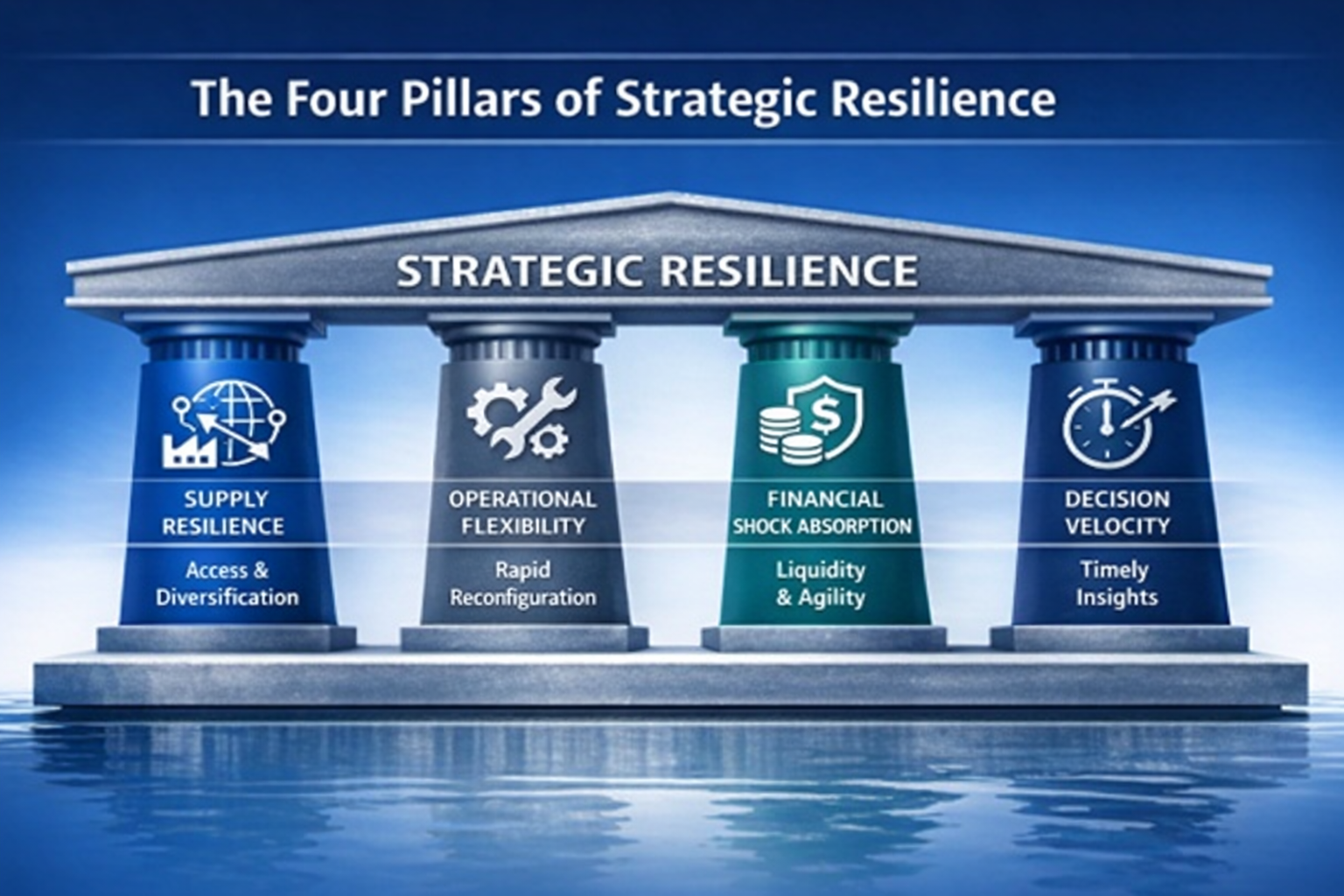
Resilience is also not about maximising redundancy at any cost. It is about making deliberate trade-offs between efficiency, risk, and responsiveness. It requires clear choices about where to build optionality and where to accept exposure. At board level, enterprise resilience rests on four interdependent pillars:
- Supply Resilience: Access, diversification, and optionality
- Operational Flexibility: Rapid reconfiguration of assets and production
- Financial Shock Absorption: Liquidity, working capital agility, and pricing flexibility
- Decision Velocity: Timely, insight driven trade offs
Together, these capabilities shift resilience from defence to advantage. They create earnings stability and, increasingly, a source of competitive advantage.
This perspective reflects firsthand experience working with regional management and executive teams through COVID era supply, cash, and operating disruptions.
Board Benchmark: Strategic Resilience in Practice
Business continuity is no longer a compliance exercise. It is a board level capability directly linked to earnings durability, capital discipline, and stakeholder confidence. The following illustrative framework synthesises leading resilience practices and is adapted for board level application:
| Dimension | Traditional Continuity | Strategic Resilience |
|---|---|---|
| Risk framing | Temporary disruption | Structural volatility |
| Planning horizon | Recovery scenarios | Multi scenario earnings and cash exposure |
| Supply strategy | Cost optimised | Diversified and flexible |
| Operational response | Ad hoc | Pretested playbooks |
| Financial posture | Reactive | Built in shock absorption |
| Decision support | Lagging reports | Forward looking insights |
| Digital and AI | Efficiency | Foresight and decision confidence |
| Board engagement | Periodic | Continuous oversight |
Board Takeaway
Resilience is not a plan. It is a governed enterprise capability that protects earnings, preserves optionality, and sustains stakeholder confidence under continuous uncertainty.
Board Questions
- Where are we structurally overexposed by supplier, country or route?
- How quickly can we reconfigure operations at scale?
- What are the quantified earnings and cash impacts of tariff shocks?
- How early do we detect disruption, and how fast do we act?
- Are decisions based on real time insight or lagging data?
Boards that cannot answer these questions with confidence are likely underestimating their exposure.
Board Oversight Practices
Leading boards are institutionalising resilience through:
- Annual integrated stress testing across supply, financial, and geopolitical scenarios
- Quarterly review of resilience dashboards with defined trigger thresholds
- Clear accountability for decision speed and scenario-based response
- Alignment of resilience metrics with capital allocation and strategic planning
Stress Test Standard and Resilience Dashboard
Boards should move beyond static reviews and adopt a forward-looking resilience dashboard, supported by annual integrated stress testing.
The structure reflects principles commonly used in financial stress testing and enterprise risk management, drawing on established resilience thinking from organisations such as the World Economic Forum, McKinsey & Company, and Deloitte. The framework is indicative and designed to support board-level oversight, with metrics, thresholds, and triggers to be tailored to the organisation’s industry dynamics, risk appetite, and operating complexity.
| Dimension | Key Risk Indicator | Board Trigger | Expected Management Response |
|---|---|---|---|
| Supply resilience | Top 3 suppliers > 40% exposure | Any supplier > 20% or country >30% | Activate alternate sourcing |
| Operational flexibility | Time to reconfigure | > 30 days | Executed tested reconfiguration plans |
| Financial shock absorption | Liquidity coverage | < 6 months under stressed EBITDA | Trigger cash, pricing, and working capital actions |
| Decision velocity | Time to decision | > 72 hours | Deliver scenario-based recommendation within 48 hours |
This dashboard should be reviewed quarterly and stress tested annually through integrated scenarios such as tariff shocks, logistics disruption, and foreign exchange volatility. Actions should be tracked and escalated where thresholds are breached, with metrics refined over time based on stress testing outcomes and evolving risk conditions. This turns resilience into a measurable governance discipline.
Closing Perspective
In a world where uncertainty is no longer temporary, resilience is not about responding better to crises. It is about governing for uncertainty.
The companies that outperform will not be those that avoid disruption, but those that can act faster, absorb shocks more effectively, and capture opportunity when others cannot. Resilience is becoming a defining source of competitive advantage.
Boards that treat resilience as a strategic asset, rather than an operational backup, are better positioned to protect earnings, allocate capital with confidence, and lead through sustained disruption.
Resilience is not a reaction. It is a governance choice.
Salman Nazir is a global supply chain and operations leader with over 30 years of experience across Asia-Pacific, Africa, and Europe. He has held senior executive roles in multinational organisations, leading large scale transformations, crisis management, and end to end value chain operations. His work focuses on resilience, governance, and positioning supply chains as strategic enablers of growth and value creation. He is also a member of the Institute of Corporate Directors Malaysia (ICDM)
The article was written by Salman Nazir.


Related Stories


 5.0
5.0  2 Minutes
AI Governance Principles for Boards: Supporting Responsible AI Oversight at Board ...
03 August 2026




 5.0 18 Minutes
Why Accelerating Compliance Transformation is Critical in an Era of Disruption
19 February 2026